Sunday, October 25, 2009

American Bounty- the award winning restaurant at the Culinary Institute of America

Two weeks ago I had the unique opportunity to dine at the Nation's best culinary school, The Culinary Institute of America. I have wanted to see the campus and eat in their restaurants since reading Michael Ruhlman's book The Making of a Chef, which I have written about in a previous post. My family and I were in Rhinebeck, NY for an antique show that we do annually. I figured that we ought to make it a point to go to the CIA for dinner given that it is only 6 miles away. This is an account of our meal at the American Bounty, their award winning America cuisine restaurant.

To start, the Greystone Campus of the CIA has a winemaking program. Each of the student-run restaurants offer those wines, so we ordered their Merlot, along with a Pinot Noir to pair with the anticipated entrees. The menu, which can be viewed on the website for the American Bounty, is rich food with big flavors. I began the meal as any Hudson Valley meal should, with Foie Gras.
It was prepared with shaved fennel, grilled artichoke heart, and a caramelized onion sauce. Now, for those of you who have not had Foie Gras before, it can best be described as rich, buttery, and, if seared properly, crispy on the outside. My wife had a crab cake appetizer that was served with a vanilla bean cole slaw and a Louisiana-style remoulade. We also ordered a seared scallop dish that was served with crispy pork belly and a smoky tomato sauce.

Being that it was the beginning of autumn, and given the fact that fall flavors are my absolute favorites, the two autumn soups were a must. The first, a butternut squash soup with creme fraiche and toasted pecans. (not as good as mine though)
The second was a sweet corn chowder. It was not a traditional chowder with chunks of goodness, but rather a creamy soup.

The ladies had salads, this one with roast beets, goat cheese, pinenut butter, and sherry-honey vinaigrette.

The second salad was a country salad with wine poached pears, blue cheese and spiced walnuts.


The entree selection was not huge, and surprisingly, no steak option was offered, unless you include a BBQ beef sparerib as steak, which I would not. We chose three options so that we all might taste and share. I chose smoked duckling served in a curried almond sauce, and preserved mango.

There was also a double cut Berkshire Pork chop served with ginger tomato jam, spicy mustard and a mound of garlic mashed potato.

And last, there was a dish that I had never had. It was a Maine Lobster burgoo. Now a burgoo is traditionally a meat stew made with some type of game or lamb. It was a peasant dish that began in Ireland or Scotland, much like Brunswick Stew. Here, it was a broth that was used as a sauce. The lobster claws were served over roasted veggies, lima beans, chanterelle mushrooms, and a carrot froth. It was rich, clean, and focused- a really great dish.


As if all of that was not enough, of course we had dessert. We chose an off-menu berry buckle with a shortbread cap served with vanilla ice cream.

I had a serving of pistachio ice cream, something that I love to eat any time of day, and this was good!

There was also a neapolitan with puff pastry, a ricotta filling, and berries.


We also had an assortment of dessert drinks. We tried the pumpkin spice cappuccino, an almond latte and a Late Harvest Vignoles from the Finger Lakes (this is a sweet wine made from grapes that are left on the vine until very late into the fall).

SO, overall, we had a great meal. It is an experience that I would recommend for anyone who wants to see the place where more top chefs have been trained than anywhere in the nation. The service is shaky, but keep in mind that the servers are culinary students who do not have front of the house experience. For more information about the restaurants at the culinary institute, go to their website at www.CIAcheff.edu.

Saturday, September 19, 2009

Delicious Beer option for the fall- Dogfish Head PUNK!


I am sort of a purist.  I like my meat with salt and pepper; I like my pancakes with syrup and butter only; and I like my beer with hops and barley.  There are, however, a few instances in life where something comes along and knocks you on your ass.  Mirco-brewery genius, and fellow Muhlenberg College Mule, Sam Calagione has created something special at Dogfish Head Brewery.  For those of you who know beer and live in the greater Philadelphia/Wilmington, DE, Maryland area, I am preaching to the choir.  

There are several traditional, but exquisite, ales crafted by Sam and Dogfish Head.  His "60 Minute Ale" is the flagship.  The 60 Minute name comes from the length of time the wort is boiled while hops are added.  This long boil time accounts for the hoppy IPA taste.  There is also a 90 Minute Ale and a famously potent 120 Minute Ale, which hits the ABV (alcohol by volume) of 18.0%.  It is a real shot of life and a rare treat.  Two and thats it.  

But this is about an oldie but a goodie.  The Dogfish Head Punkin (this is a link) pumpkin flavored ale is fantastic.  It is everything you want in a specialty beer and nothing you don't.  The pumpkin is subtly fused with a smooth full-bodied brown ale.  There are clear hints of nutmeg and allspice, but I don't really taste the brown sugar.  It pairs incredible well with a little chocolate.  I never would have really thought of this, but I bought my wife some chocolates the other day, popped one in my mouth and opened one of these Punkin Ales.  The cocoa really brought out the flavors of the beer.  

All said and done, everything (well almost everything) Dogfish Head brewery creates works.  There are a few low points, but nothing worth even listing because I think everyone is entitled to a bias-free taste-test.  I suggest the 60 Minute Ale highly.  For something more hoppy, go to the 90 Minute.  If you are daring and want to spend the money, get a bottle of the 120 Minute Ale.  For those of you within an hour of Wilmington, DE, it is worth while to go to Total Wine and buy by the bottle.  (Sorry people in PA)  Also try the FANTASTIC Aprihop Ale, it is a hoppy fruit ale that is really enjoyable.  

Eat, Drink and Get Drunk.


My BBQ sauce

Upon the request of an avid reader, I am disclosing to the world the secret of my BBQ sauce.  I do this with great trepidation, but the avid reader is my mother- I would like to see you say no to her.  So, there is no real recipe in the traditional sense.  I think recipes are a good basis for a process that you, yourself, can perfect.  All I can give you is my process and let you create your own taste.  

So, I start with standard ketchup.  I know it seems pedestrian, but there is no other option.  To that I add a bevy of spices including the following in the order I add them and in descending quantity: chili powder, cumin, smoked paprika, hot paprika, garlic powder, ground ginger, mustard powder, onion powder, fresh ground pepper, and only a dash of salt.  There will be enough salt from the other things added, so you don't need much more.  I do have one more secret, but it is a little...I don't know...remedial.  McCormick makes a roasted garlic and herb seasoning for chicken.  I add a dash of that for a little depth of flavor.  

Now, getting away from the store-bought ingredients, I stir the mixture of ketchup and spices together and let it simmer for a minute or two.  Now, it is always important to connect sauce with main dish.  When I slow-cook my ribs or pork shoulder, I place them in a roasting pan and fill the bottom pan with a mixture of apple cider vinegar and some of the dry-rub I put on the ribs.  So, a tablespoon or so of apple cider vinegar goes into the pot of BBQ sauce.  Also, in the dry-rub I add about a half of a cup of brown sugar for caramelization when I put the ribs on the grill.  So, into the pot goes brown sugar and white sugar.  Add all of these ingredients to taste, meaning add some, taste the sauce, and determine f you have added enough or need more.  You shouldn't be able to taste any one ingredient, but just the note of flavor the ingredient brings to the dish, or in this case, a sauce.  

Thinking about flavor profile, we now have salt, acid (vinegar), sweet (sugar), and bitter (mustard powder and other spices).  This is the makings of a very nice, rich and deep BBQ sauce.  Please do some trial and error and post your results.  Your preferred taste will probably be different from mine, so adjust amounts as you like.  Be careful with the vinegar however- it is easily overdone.  Enjoy.


Monday, September 14, 2009

When To Season Meat- Lamb

For the Labor day weekend, I decided to have a family cook-out at our new house.  Knowing that I was having both of our (My wife and I) families, I knew I would have to have a healthy dose of meat.  My wife's family is known for expressing love through copious amounts of animal carcass and creamy french cheese.  My family often just prepares food for 25 people when there are only 10 coming over.  So, to make both families proud, I put together the following dishes:

1) Hand-cut coleslaw with homemade dressing; 2) Potato salad with fingerling white, red, Japanese Purple Sweet, and fingerling sweet potatoes, celery, and egg; 3) Arugula salad with shaved Pecorino Romano cheese, freshly boiled red beets (blot them totally dry so they don't bleed into the salad), with a dressing of red apple balsamic vinegar and black truffle oil; 4) 2 racks of pork ribs- one baby back and one spare, dry rubbed the night before, slow roasted in the oven, basted once with homemade BBQ sauce, then finished on the charcoal grill, see here, for a nice crispy, smokey finish (recipe and method forthcoming); 5) Two racks of New Zealand lamb; 6) homemade chocolate chip and pecan cookies or peanut butter Heath Bar cookies (100% my wife); 6) Of course you need a few hot dogs an bratwursts for the fillers; 7) 14 ears of corn that never really made it to the table because everyone was so full.  There was also contributions from family including macaroni salad, pies, ect.  

But this post is about the Lamb.  It was clear that the racks, seasoned 8 hours before cooking, were by far better than others I have cooked that were seasoned earlier.  I did not even bother with the 4 hour or 1 hour season because of the fat content on the top-side of the racks.  There was a nice thick, dense layer of fat that, when I began to cook them on the VERY hot grill, melted into the rest of the meat and made the taste incredible.  I did not get any pictures of the meal, but I can assure you that Lamb is best seasoned at LEAST 6 hours before cooking.  Season very liberally with kosher salt and freshly cracked black pepper.  My sister-in-law asked me if I used anything else because the taste seemed different, but that was all- just salt and pepper.  

One tip, however, for seasoning racks of Lamb.  When seasoning the top layer of fat, just when you think you have seasoned it enough, season it again.  It takes a lot of salt to season that dense of a layer of fat.  Also, when you cook the rack, the fat will render and run into the coals.   That is flavor leaving the final product, so you have to make sure that enough remains.  You might also want to season in stages.  Season once, then come back to it a few hours later and throw another fresh layer of S&P on the meat.  

So, go get some Lamb and don't forget to wrap the frenched bones in tin foil BEFORE you put the meat on the grill.  Otherwise you will loose some bones to the heat like I did (I forgot and tried to wrap them after a few minutes on the grill- ouch).  Also, don't forget to let the meat sit for about 5-10 minutes before cutting.  130-135 degrees on the thickest part of the meat for a nice medium-rare to medium, so take the meat off the grill at 125 or 128 and let the carry-over cooking do the rest.  

Tuesday, September 1, 2009

Fall Food is Coming

I know everyone loves summer for the hot temps, beach (or if from Jersey, shore) weekends, and fresh produce.  I have to admit that I love tomato season too.  But there is a time of year that is unequivocal to me, and that is autumn.   I am not trying to rush it, but the smell of falling leaves and charcoal grills, the taste of butternut squash puree with rosemary and thyme roasted pork tenderloin topped with stone roasted apple and pear chutney...I could go on and on.  Not to mention football season, tailgating, pumpkin beer, Octoberfest beers, big bold red wines that you have let sit all spring and summer, aged scotch... here I go again.  

That should suffice to say that my blog will be pushing out a post or two a day in the fall.  So stay tuned and get ready for some killer recipes, great events, and reviews of the best fall drinks.  

Friday, August 28, 2009

Seasoning and Grilling: Tools of the Trade


Ok, so I have gotten some questions about the seasoning series I have been doing and talking about. (By the way the lamb is being cooked tonight and seasoning has already begun)  When I season meat, I use a base of kosher salt and medium grain fresh cracked pepper.  Sometimes I will add a little garlic powder or onion powder if the side dished call for a complimentary flavor.  For instance, when I cooked the ribeyes pictures below, I used only salt and pepper because I was serving homemade potato salad (with white, red, and purple potatoes, celery, homemade mayo, cumin, paprika, salt, and pepper) and hand-cut coleslaw (napa cabbage, sliced carrot, raw onion, my secret slaw dressing, cumin, paprika, salt and pepper).  I debated dashing a little cumin and paprika on the steaks to compliment the other dishes, but these spices can burn and taste a bit nasty.  Also, the flavors would not be that pronounced in the other dishes, thus difficult to pick up on the steak.

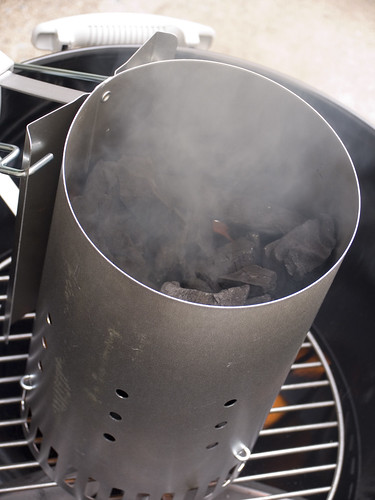
As for choice of grill, I have the luxury of a two grill system.  I start my meat on a super hot Weber grill, and always with natural hardwood charcoal.  Lighting this type of charcoal can be a pain in the ass, so get yourself one of these, a chimney starter.  Once you have the chimney filled with enough good lump charcoal, get some newspaper and put about 1-2 oz. of vegetable oil on it so the paper burns longer.  Place the paper under the chimney and let it work.  After about ten to fifteen minutes, wearing a fireproof glove or a thick oven mit, pour out the red-hot coals into the grill.  Get yourself a long pair of tongs, and evenly distribute the coals.  Let them set up and burn off any grim on the grate where the meat will be.  Place the steaks on the grill with the longest points facing 2:00 and 7:00 on a clock.  After about 2-3 minutes, depending on the thickness of the meat (this is for a steak about 3/4'' or 1'' thick) turn the steak to face 5:00 and 11:00 on a clock and cook for 2-3 more minutes: this is for pretty grill marks.   Flip and repeat.  

Now if you do not have a gas grill, at this point you want to move the steaks to a cooler part of the grill and turn the air system to closed so the heat dies down.  I, on the other hand, have already placed a tray in my gas grill and turned the burners on the lowest setting.  I place the steaks in the 250-300 degree gas grill to finish, much like I would for inside cooking on the stove and in the oven.  If there are people who want to mistreat their meat and overcook it, then allow for a few extra minutes on the charcoal grill or longer cooking in the gas grill.  Remember though, you have to add even minutes on both sides of the meat, or there will be uneven cooking from side to side.  

Other foods that are to be grilled should can be placed on the charcoal grill after the meat is tucked into the gas grill.  Things like onion slices, corn, and poblano peppers are nice on the grill, as well as hot dogs or hamburgers for people who are not looking for a steak.  If you are considering chicken as well as steaks, you ought to cook the chicken first and let that carry-over-cook while the steaks are grilling.  If you try to do the chicken after the steaks, it will take too much time to cook and the steaks will either get cold or overcooked in the gas grill.  Remember though, all meat needs time to rest after cooking, so cook to 5 degrees under temperature and let the carry over time finish to a nice 128-130 degrees on beef for medium rare.  

For any other questions regarding proper grilling techniques, please leave comments and I will be happy to answer them.  

Monday, August 24, 2009

I'm on a Quest...A Quest for Meat

"They call me The Seeker 
 I've been searching low and high
 I won't get to get what I'm after
 Till the day I die"
-The Who

This quote runs true to my life in the recent few months.  What am I searching for you ask? Well, I am searching for that which all good cooks ought to, the best ingredients possible.  Recently, the product that has disappointed the most is meat.  Besides the lovely rib-eyes I cooked last week, I have been devoid of really impressive beef, pork, lamb, chicken or any other tasty animal to eat.  So, I went on a quest for good carcass.

I had heard about a few places in the area that claimed to be premium butcher shops, so I made the trek out into the hot summer in search of something seemingly common: rack of lamb.  I obviously wanted to conduct the next phase of my "When to Season Different Meats" series.  Can you freaking believe that I could not find a fresh rack of lamb (and by fresh I meat not dry-sealed and shipped from New Zealand) anywhere.  It was not a surprise that the mega-marts did not have anything other than imported, so I don't count that.  

I was surprised that these "butcher shops" did not have what I needed.  I went to two butcher shops.  First was the Westtown Butcher Shop and Deli.  This diminutive establishment on Rt. 202 south (you can access from the northbound lane) doesn't seem like much from the outside. Once inside, you will not find much more.  There are a few roasts in the case that may be trimmed into steaks, and a few loose steaks as well, but nothing special.  There are lists of available products, but not much in the case.  If you are like me, you like to see, touch and smell your meat before purchase.  Here, I did not get the opportunity.  More importantly, there was no lamb at all.  An overall disappointment.

The second place was a brighter light in my day.  The Country Butcher, www.thecountrybutchermarket.com, had much more to choose from.  The beef in the case was all marked prime, and looked it to me.  The weekly special was bone-in rib-eye for $11.99/lb.  Is that expensive?  Yes, it is.  But is it worth it, you better believe it.  The difference from prime beef (this beef, and fine dining restaurant beef) to choice beef (what you get in the mega-mart) is drastic.  Beyond these steaks, there were fresh pork chops, pork butt, country style ribs (single cut meaty back ribs either boneless or with bone- get the bone-in, they are tastier) and other assorted chops.  There were lamb chops, but no racks.  They stocked a frozen section of some more exotic meats like bison, squab, tongue, rabbit, ect.  Frozen meats are tricky and ought to be purchased sparingly (never get squab, quail, or other small game birds frozen or they will be dryer than a session of Congress).  Overall, not a bad butcher shop.  The Country Butcher also had a nice bakery, cheese, and gourmet food sections.  Give it a shot.  I will continue to look for good local lamb for the next of the "Seasoning" series.